Friday, March 16, 2012

Thoughts: The Last Story (Wii)


I would not blame anybody for playing Last Story for an hour or two, declaring it to be dumb and moving on. The game drops you in the middle of a combat mission with 4-5 allies, none of which explain what is going on. Everyone is talking back and forth as if you had been playing the game for 10 hours. The battle system is complicated and confusing thanks to the fact that there's nothing else like it: a real-time action RPG with about a dozen different systems and mechanics tacked on. The easiest way to explain it is a cover-based melee game with tactical RPG elements (see below). Battles aren't hard, but combine this with the lack of exposition to start and you've got a game that's not exactly user-friendly.


After a few basic battles, you get to a town area. The town area is large and feels like it's trying to pull off the bustling city feel of Assassin's Creed, except this is the Wii and it can't handle it at all. The framerate drops to about 10 fps. Your character's movement feels very slow and clunky, whether it be because the system can't handle the amount of detail or because the frame drops are so frequent that you're basically playing in slow motion. The controls are awkward due to how crappy the classic controller is -- something that could be fixed by having the more expensive one, probably, but that's their fault. The graphics are all washed out and drab, much in the way that modern next-gen games are. In many ways, Last Story seems like it's trying to imitate western-made, high-budget PS3/360 games.. except that it's a Japanese RPG on the Wii and none of this makes sense. The whole game feels clunky and jarring.
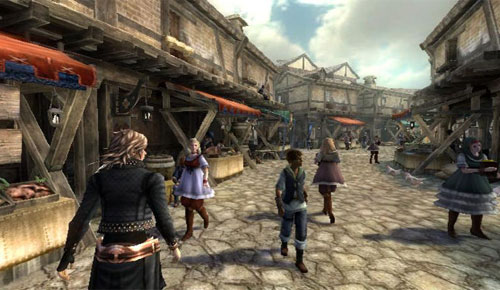


After 3-4 fetch quests that slowly orient you to the huge city that you're in, you meet a girl that's running away. She is the spitting image of every female protagonist that you've ever seen: weak, clueless, mysterious, magical and attractive. The main character and her run around the city for a while, talking awkwardly and looking at stars and talking about their sad lives and all the things that JRPG protagonists do in every other JRPG you've ever played. The character is still moving slower than you'd like and none of this is particularly interesting. The pedigree of the developer makes you push on, but if this had a different name on the box I probably would drop it right about now.
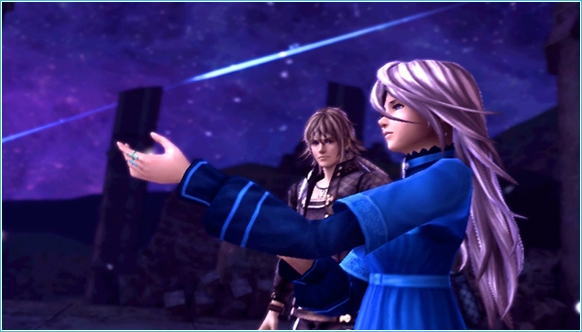


And then, finally, something interesting happens. The game climaxes and things blow up all over the place. You get to play with the battle system some more and it slowly starts to make sense. The characters start to become more interesting due to actually having some impactful events happen. After 4-5 hours of having no idea who these guys are, it starts to click. Antagonists finally show up. It's starting to feel like a PS1 Final Fantasy game and that's a really good thing. The things that Last Story is going for narratively are not particularly original, but they're fun. There's something to be said about fighting a battle that has some emotional weight to it instead of just slaughtering random packs of bugs for no reason.

The Last Story is kind of a crazy game. It's really creative in some ways and utterly devoid of content in others. There is so much to the battle system that mechanics are still being introduced as late as 3-4 hours before the ending. The game has a battle tutorial that seems to pop up every other fight for the first five hours, and is maybe the only RPG battle tutorial that I've had to refer back to after the fact. At the same time, the heart of the battle system is walking up to an enemy and letting your guy auto-attack him to death, whereupon you'll find a new enemy to do it to. This isn't a complaint -- you can turn auto-attack off if you want and make it more of an action RPG -- but sometimes the complexity of a battle system masks the fact that you're really just letting the game play itself. Ultimately, the battle system is a positive because a.) the fights are fun to do and b.) killing enemies and getting loot is pretty rewarding. Plus I have to give Last Story credit for trying something new.


I don't know how you could possibly be hiding when your sword is that fucking big, but whatever.

There is exactly one town in Last Story, and it's more of a hub world than anything. You visit a tavern, the streets, a castle and some shops. Occasionally you'll walk around and talk to people on a ship but that's it. The dungeon areas are narrow, linear pathways with large rooms for large-scale fights. Level design-wise, it's very similar to a character action game like God of War or Devil May Cry -- or, if you want to go that route, Final Fantasy XIII. You'll get large circular rooms so you can face off against foes and small branching pathways to pick up treasure chests. Action is broken up into 15-20 minute 'chapters', and you can sometimes finish a chapter by just talking to people or hitting a trigger point. It feels bizarre to be on chapter 18 in 3 hours of play, but that's just how Last Story rolls. It's bite-sized and modern. The game is over in 25 hours, 15 if you ignore the sidequests (which are trigger points followed by a scene fight or an arena battle, mostly). All of this could be seen as a negative -- or it can be seen as cutting to the heart of what makes an RPG so good: pacing, boss battles and good scenes. Last Story does a very good job in these areas, and while the bosses are standard large monsters that aren't very engaging on a narrative level, they make good targets for the unique battle system. For all of the things Last Story does wrong, it manages to nail the gameplay in a very satisfying way.

I don't think there are more than 15 named characters in the entire game, and you start out with half of them in your party. Antagonists are largely absent, replaced by a political plot focused on an external threat of invasion that is never quite explained. And yet the characters that are there are quite excellent: they seem fairly one-dimensional at first, but I'd call Last Story's cast one of the least offensive in the history of the genre. Every single character resonates in some way and the localization is fairly impressive. There are no annoying kids -- or any kids at all, really -- and no stupid characters that have no purpose other than to annoy you. Last Story's characters won't hit the highs that other games in the genre may have, but it also lacks the usual whiny, insufferable garbage. By the end of the game -- one that isn't particularly long -- you're fairly attached to this rag-tag bunch of misfits.


When Last Story ramps up towards the end, it kind of takes you by surprise: hey, this game is kind of fucking awesome. It kind of sneaks up on you and suddenly you can't put it down. The pacing is strong and the characters keep the so-so plot on track. The framerate is still crazy and the colour palette is still washed out, and it's extremely limited in scope, but you start to ignore that and instead enjoy all of the crazy things happening on-screen. You start to get some really strong weapons and abilities and you really look forward to the next battle. Everything just comes together at the right time and it feels triumphant. Holy crap, this game is actually firing on all cylinders. It may not always be awesome, but it will definitely be memorable. It's got heart, it's fun to play and it's unique. Japanese RPG fans should definitely give it a try.

Wednesday, March 14, 2012

Thoughts - Persona 3 Portable (PSP)

Been meaning to get some thoughts on paper (textbox?) lately. Here's my attempt at writing a mini-essay about a game I have real thoughts on.


Persona 3 is a long damn game. It manages to stretch what should be a 20-30 hour adventure into 60-70 hours due to pure repetition and grind. The game consists of one endless dungeon that spans literally hundreds of floors, and the design of the floors never changes with the exception of a change to the tileset. Every on-screen enemy that you find in these dungeons looks the exact same from the first hour to the last. You will hear the same dungeon and battle song for dozens of hours, and while you can change the music if you want, it’s usually not worth it.

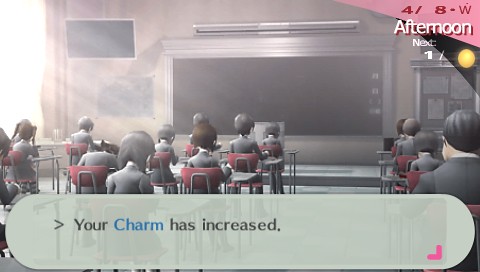
Persona 3 splits its gameplay into two main sections. During the day, you go to school, take tests, make friends and advance your relationships. This process, like most things you’ll do in Persona 3, is very repetitive and without a whole lot of depth. You talk to a person, say you want to spend time with them, make a couple of choices which will advance your relationship in various ways, gain a relationship level and then go back to your dorm. Every relationship has 10 levels and advances in much the same way. The times of the day are segmented in much the same way as the relationship levels: during school, after school and evenings.

At night, you go into the endless dungeon and kill shadows. After battles, you collect monsters called personas and can combine them into new monsters at the entrance to the dungeon. Your aforementioned relationship levels give you experience bonuses upon creating new monsters, and beyond this, the school sim and dungeon aspects are completely separate.

Even the story sections of the game are compartmentalized. Every major event happens when a full moon comes, and by “major event” I mean “boss fight”. For the first 75% of the game, there is little to no storyline, just a general “we gots to stop the shadows!” theme that never really resonates (or even tries to resonate, really). Persona 3 is a game based on the gameplay – there are story bits and they can get pretty expansive towards the end of your 70 hour quest, but overall, this isn’t a game you’re playing to advance the narrative.

Instead, you’re playing against the clock. Everything in Persona 3 is timed: certain people are around at certain times. Your day is split into 2-3 time blocks. The boss fight will come in x number of days, a number that is prominently displayed on the top of your screen for the entire game.


The purpose of playing is to strengthen your character in time to be able to handle the next major event. You continue doing this until your quest is at an end. At no point is it about anything other than getting stronger. Strengthening your relationships so you can strengthen your personas so you can level up your characters so you can learn new skills so you can advance to higher levels of the dungeon so you can gain more experience so you can level up your characters better so you can beat the boss, and to beat the boss you’ll want to strengthen your character relationships so you can strengthen your personas… and so on. It never ends. It is an endless cycle, just like the moon that is sitting on your screen with a number telling you how much longer you have until some evil shadow is going to jump you. When you finish playing Persona 3 – whether it’s by choice or because you finished it – it’s more a feeling of relief, of getting rid of the constant time pressure that you’ve been under for dozens of hours. A weight lifts off of your shoulders and you live life just a little bit slower.

And despite all this, Persona 3 is probably in my top 10 games of all time.

I cannot think of a game with a better sense of progression than Persona 3. There are an infinite number of small improvements you can make to your characters, all of which make you feel really good. Everything in Persona 3 is very carefully and deliberately designed with progression in mind. You have a limited amount of time to get everything done, forcing you to make hard decisions about how you’re going to spend it on a day-to-day basis. Should you level up your academics stat so you can do well on the test so the smart girl will pay attention to you? Or will you work on advancing your courage stat so you can impress a sports team? Do you want to ignore all stats and friendships and just pay money to increase your stats? Or will you forget all that and just hang out with a friend and advance that social link? Or you can skip all that and just level up in the dungeon – but you can only do that for so long each night because your characters will get tired. Unless you’re just blindly following a FAQ from beginning to end, you can’t do it all. You have to pick and choose how you develop your characters.


The game has a level of difficulty to it that demands smart decision making. This extends to more than just battle. Having the right combination of skills means everything in P3 and the easiest way to advance your characters is to create personas using those social links that you’ve forged during the daytime. Persona 3 isn’t hard so much as it is smart: you have to make the right choices in battle and one mistake will kill you very, very quickly. The battle system has a high risk/reward aspect to it since you can get bonus turns for hitting opponent weaknesses. The key is to have the skills that you need in order to maximize your chances of success. Persona is notorious for stories about missing an attack on an enemy and getting utterly annihilated because the enemy went after your weaknesses and killed you without you getting another turn. That sense of tension – that you can die at literally any time – is key in making the game’s choices feel worthwhile.

There are so many stats to advance that you often feel like there’s no right thing to be doing. You end up playing favourites and picking out what you like best. Maybe you want to ignore the kid that likes to eat and instead want to hang out with the kid that’s dying and wants a friend. Or maybe you think that kid’s a whiny brat and you want to just sit at home and play an MMO, complete with netspeak. Persona 3 features some smart writing that keeps you engaged despite the silly premise.


Perhaps the most important thing to making this all work, and something exclusive to the PSP version of the game, is how incredibly fast the game plays. In P3P, you don’t even control your character directly: instead you move a cursor around the screen. You can instantly warp to anywhere instead of having to walk around. You can hold a button to have text zip past the screen at 100 miles an hour. There’s an auto-attack button in battle that makes things fly. Battles go very fast thanks to the fact that you’re either going to murder the enemy or see the game over screen within 15 seconds.


Combine the endless sense of progress, along with the blistering pace at which you can make time pass and you have an incredibly engaging game, one that’s very hard to stop playing. Persona 3 Portable turns me from a regular person who likes to play video games into an addict who is sitting there slamming the button to get a new ability, level or item. It’s classical conditioning at its apex and it’s incredibly effective. I sit there drooling like a brainwashed animal waiting for the next level up jingle to play. When I do get it, a smile comes across my face, I breathe a sigh of relief and do it all over again. Suddenly it’s 2:30am and I don’t know what I’ve been doing for the last four hours. It’s heroin in video game form and I cannot get enough of it.


I love this stupid game. It’s got great music, an awesome sense of style and all those things that everyone likes in their RPGs, but ultimately It’s not about that. That’s not why the game is so good. It’s everything smushed together and how the game functions as a whole instead of dissecting the individual systems. The recipe is just perfect.

Tuesday, August 2, 2011

Review - Insanely Twisted Shadow Planet


One thing is for sure: the developers of Insanely Twisted Shadow Planet did not compromise. They had a vision for the kind of game they wanted to make and they made it. No corners were cut and no artistic vision was shuttered in favour of mechanics or game design. It is admirable to see a team go for their vision with laser focus like the folks at Fuelcell games did.

Insanely Twisted Shadow Planet is the equivalent of a film short. This is because the man behind the project, Michel Gagne, is a famous animator known for doing these types of movies. Like many film shorts, ITSP is a silent game. The game's music is nothing more than a few ambient whirrs here and there. There is no dialogue in the game. The closest thing to a narrative are a few esoteric five second animations about, well, nothing at all. There is very little purpose shown here. Even the weapons that you acquire are nameless and simply go by a symbol on an equip screen. Your only source of information is a scanning device that lets you interact with objects to learn how to manipulate them. This will show you what device of yours can interact with said object. No words, no understanding, just a symbol. Perhaps the most striking thing about the game is the lack of a HUD. There are no life bars, no on-screen symbols, no anything. Everything is implemented in-game.


This silence is a double-edged sword. On one hand, the game's atmosphere is enhanced greatly by this silent, unknown world. On the other, you are often given no context or understanding as to what is going on or what to do. The game has a unique control scheme where you have four hotkeys that you can assign to your eight weapons, but there is no way to convey that. Even the help menu is a series of obtuse pictures. It wasn't until the end of the game where I truly started to recognize which symbol corresponded to which weapon and felt comfortable cycling through them on the fly. You will sometimes die without knowing that you are close to death due to the lack of a life bar. Many people will feel some dissonance with ITSP thanks to its absolute refusal to convey basic things to the player.

And yet, this unknown quality ends up being a strength of the game. Insanely Twisted Shadow Planet is ostensibly a Metroid game. Metroid is a game that thrives on its setting and its atmosphere. ITSP's worlds are very alien and disconcerting thanks to several factors. One is Gagne, the game's creative director and animator. Gagne is the game's greatest strength: ITSP's art has a unique twisted cartoon look to it that fits into a video game perfectly. Exploring the game world is a real thrill thanks to how menacing the environments are. The animation is second to none. The attention to detail is striking for a downloadable game. Every animation is a thrill to see. Combine this with the silent movie aesthetic and the game has an atmosphere that, blasphemous as it is to say, trumps Metroid in every aspect. If video games were all about art, setting and atmosphere, ITSP would be one for all time.

It actually isn't the gameplay that stops ITSP from being great. The gameplay in ITSP is really good. Movement feels really smooth, weapons feel really good and enemies have great variety. There are multiple ways to take on each enemy thanks to great weapons: a saw that functions as a melee weapon and feels very visceral, a rocket with tons of power and limited mobility/speed, a laser beam that fries enemies but needs time to recharge, a grappling hook that can pick up just about any enemy and render them helpless, a shield that deflects near anything and a gravity beam that can send enemies flying. You can even smash enemies against walls to kill them. Boss fights and large enemy encounters will often find you cycling through weapons like crazy instead of just finding the best available weapon and blasting everything until it's dead. It is a testament to the gameplay that this works so well.

Level design is where ITSP falters. The game has a great sense of pace thanks to traversal being so intrinsically interesting. Using these weapons is a lot of fun and killing enemies is a delight. ITSP grinds this pace to a halt by using environmental puzzles so liberally. Every area has a different environmental theme and corresponding type of puzzle for you to solve. Puzzles start out simple but end up getting fairly devious thanks to the game's steadfast refusal to give you any kind of context or hint. Oftentimes you spend 10 minutes wandering around an area trying to figure out what's missing or where to go. The puzzles are fairly clever and offer good use of your weapons but wandering back and forth through the same rooms over and over really ruins what makes the game so fun: pushing forward, discovering new places, seeing new environments and killing new enemies. Compounding this is the fact that ITSP's level design funnels you toward everything in sequential order. A true Metroid game would let you tackle things however you like but ITSP has a handful of one-way passages that force you to go a very roundabout way, even at the end of the game. For those looking to collect all of the items or see all of the different places, this is particularly maddening.

Insanely Twisted Shadow Planet is a great attempt from a very creative team. Its sharp visuals, smart use of weapons and great boss fights make it a game to remember and recommend to anybody. Unfortunately, its level design and odd linearity stop it well short of being on the level of a Super Metroid. ITSP succeeds 85% of the time at being amazing. The other 15% make you wish they had a bigger budget, a better understanding of what makes the game good or something. I hope this team stays together for another game because it could be fantastic.

Monday, June 6, 2011

e3 2011, day 0

What I am about to say is nothing new. I might even suggest not reading it.

I just need to get it out of my system.

Today is day 0 of e3, the day where we as a gaming community engage in press conference wars. Everyone collectively blows their loads and shows what is coming out for the rest of the year, all in very exquisite detail. Today was Microsoft, EA, Ubisoft and Sony.

Microsoft started by unveiling Modern Warfare 3, the game that will sell tens of millions of copies when it releases in November. EA countered with Battlefield 3; Ubisoft showed off Assassin's Creed 2, part 3. Sony came out strong with Uncharted 3. Everywhere you looked, there was a 3: Mass Effect 3, Saints Row 3, Bioshock 3, Resistance 3, Far Cry 3, Gears of War 3. It's almost comical how many 3s are battling for the right to sell millions of copies this November. Since, you know, they're all coming out that time because they're the biggest things on the market.

I actually don't mind sequels THAT much. Many of them improve on the previous product. Some add new features or new mechanics and refine a preexisting product. Bioshock Infinite, for instance, looks really awesome. Uncharted 3 will be supremely good. I don't really like Mass Effect but I'm sure that game will be in good shape come next March.

But what IS bothering me is the obsession with guns. You've heard this before and it's a tired argument, but it is rare that the gun obsession with the gaming industry beats you over the head about it like it did today. I must have watched ten thousand bullets get fired today and I didn't even watch all the press conferences. After the Ubisoft conference I had a splittling headache from listening to guns fire in my ear for the 7000th time. It was impressive.

Video games are limited in that they need to be interactive. The easiest way to be interactive is to try to overcome an objective, and the most efficient way to do that is to kill them. 95% of games are about killing dozens and dozens of opponents in order to reach your objective. People like to feel empowered from shooting things. I can't blame them. Shooting somebody in the face is a strong thing that should resonate with a person.

But there has to be a limit on how far we are willing to go. Today I watched game demos or game videos of Modern Warfare 3, Tom Clancy's Ghost Recon, Gears of War 3, Fable: The Journey, Halo: Combat Evolved Anniversary, Halo 4, Battlefield 3, Far Cry 3, Brothers in Arms, Overstrike and Resistance 3, and you can extend that to games with shooting as the main gameplay focus with other elements attached like Bioshock Infinite, Mass Effect 3 and Uncharted 3. There was even some kind of PS3 shooter named Dust that linked up to the MMO Eve Online. They actually went and made a generic console FPS to fit in with a PC MMO. Impressive.

I have never been about the press conference war because the kinds of things I like are generally more creative offerings that can only really thrive on smaller budgets. I am 100% sure that day 1 of e3 will offer me more than the Sony/Microsoft cold war of guns and motion technology. Everything is either a dumbed down game for kids or a game dedicated to killing people in the most surgical way possible.

What's wrong with something inbetween?

Tuesday, May 17, 2011

Realism and the Modern Era

I miss when video games were, y'know, video games.

That's an overly dramatic and exaggerated statement, and quite frankly it's a really stupid one too. But it's often how I feel about the current state of games. So many games today are focused on creating an experience or forming a narrative that they often seem to lose sight of why people play video games.

I've been playing Outland, Housemarque's sublime 2d action game that blends elements of bullet hell with classic Metroid-style adventure. Outland has what many people would call a retro or oldschool style: you hit start, there's a quick cutscene explaining the game and then you're in and playing. There isn't an expansive backstory to what's going on. An in-game tutorial might consist of a quick on-screen message telling you that pressing down + jump will cause your character to slide. There isn't any dialogue outside of a narrator explaining the origin of the world and even that's a little heavy-handed for a game of this style. Simply put, there's no fat to Outland. Everything that's there needs to be there and adding anything more would be counterproductive.

Several other things stand out in Outland. The first is that it employs a unique mechanic that doesn't really make sense but is awesome to play with. Outland features a polarity system that is ripped straight out of Treasure's classic shmup Ikaruga. You can switch between light and dark and absorb bullets of the same colour while you can only hurt enemies of the opposite polarity. Why can you do this? Who knows. It's not explained and frankly it doesn't need to be. Sometimes it's more fun to just play with something unique and fun rather than have everything make sense.

Outland often has enemies of light polarity hiding inside a wave of dark bullets. Why don't the bullets hurt the enemies when they hurt you? Because that would ruin the game. It doesn't matter if the game doesn't follow the rules all the way through. It's all about crafting a gameplay experience that makes you feel good while playing it. Outland often has sections where you're dealing with enemies of one colour while two different streams of bullets are filling up the screen. You're constantly shifting around the screen and changing polarities. The gameplay is exciting and frenetic to the point where you sometimes take a step back and marvel at what your hands are doing. Outland is a game that makes your hands feel smart.

Most modern games lose this sensibility. For example, this week I've been playing Assassin's Creed. Assassin's Creed is a fun game: flawed as hell but enjoyable nonetheless. Like Outland, Assassin's Creed takes elements of preexisting games and patches them together into a new experience.

Begin playing Assassin's Creed and you're treated to a trippy sequence where you're not sure what is real and what's not. You're then left playing catch-up as pseudo-main character Desmond also trying to figure out what the hell is going on. From there you're jammed into some kind of reality simulator where you will then go through a 10 minute tutorial on all the nuances of the controls. There are no less than 15 unique buttons and you have to hold buttons down in order to access some of your commands. Once the tutorial is done, you then go into the real game where there's a longer, more expansive in-game tutorial. All told, it will be an hour before you can actually play Assassin's Creed.

The issues do not end there. Assassin's Creed is a game that strives for realism. The game has you doing some seriously mundane tasks: riding a horse in a straight line for ten minutes to get from location to location, patrolling the streets to look for information on where your assassination target is, cutscenes that are utterly uninteresting and lack any kind of persuasive narrative. I am told that the game's narrative picks up towards the end but that strikes me as a huge design mistake. The payoff should be throughout the game and not jammed at the end after you've done everything.

But there's a larger issue with Assassin's Creed that really stands out in my eyes: realism. This is a game that focuses on being a real person with real abilities. Everything that you do in Assassin's Creed is based on the rules of reality. Powerups are in the form of new weapons to kill people or new ways to knock guards down. Compare that to a game like Outland where you might get a power that lets you absorb bullets and use them to destroy all the enemies on the screen. You will never find anything like that in Assassin's Creed.

There is but one enemy type in Assassin's Creed: humans. They might give them different weapons but ultimately they're all the same. The game is restricted by the rules of nature. There's a nifty parkour mechanic that keeps it interesting as you climb from ledges to rooftops, but that's the only thing making the game stand out from a gameplay perspective. And the gameplay is often compromised by having menial tasks to do or having to sit through drab scenes. If Outland is a lean game then Assassin's Creed is a fat one, full of nonsense and tedium.

Let's take a better game: Uncharted 2. Uncharted 2 would get my vote as the most impressive game made during this generation: amazing cinematics blended with exciting gameplay mixed with decent shooting mechanics and fun platforming. Still, Uncharted 2 has the same limitations that Assassin's Creed does: a limited array of actions and enemy types. The platforming -- if you can even call it that -- comes down to finding the spot where you can jump and following that predefined path to its only conclusion. The different enemy types are defined by how many bullets they can take and what weapons they have. Later on you encounter some weird blue guys that seem like Avatar ripoffs (though Uncharted 2 probably predates Avatar), but overall it's nothing new. There's no mechanic in Uncharted 2 that stands out. You can run, you can jump and you can shoot a gun. Again, it's based on reality. The focus is on shaping a narrative over offering a game that's fun to play on its own merits. Uncharted 2 is absolutely successful in this regard.

But why have we gone down this route so heavily? Why is everything so heavily based on realism and a narrative? This can sound like a 2d vs. 3d thing or an old-school vs. new-school philosophy, so let me offer another example. Shadow Complex is a fun game, the very essence of Super Metroid channeled for the new era. But where Shadow Complex falls short is in its inability to offer anything different from beginning to end. In the beginning you are shooting regular people with a gun and in the end you are still shooting regular people with a gun. Shadow Complex features some fun mechanics like a speed boost and a triple jump, and the progression of the character from weak every-man with a flashlight to armoured supersoldier is very fun, but the graphic style is extremely plain and the enemies are as well. Compare that to Super Metroid, where you fight dozens of different types of enemies and progress through all kinds of different environments. Shadow Complex, by comparison, are a bunch of military complexes for 90% of the game. It is visually uninspired due to the constraints of reality.

Video games have amazing potential. We have the ability to create amazing environments and incredible variety, but most modern games seem to strive for hyper-realism and an obsession with crafting a story. It is a testament to developers today that this generation has been the best one for games: there are 2d action games and sprawling RPGs and space operas and online beat-em-ups and who knows what else. And yet it would be so much better if we took a step back and asked ourselves why we keep striving to make live-action movies instead of going for a fun gameplay idea or something completely alien and unique. Why are we always a human fighting other humans? Why not some bizarre creature? Why are we always in a city modeled after one of our own? Why not an alien planet or an underground world or something truly unusual? Isn't the point of video games to be an escape or to offer something you can't do in real life? Why settle for real life when we can strive for something more?

These are the directions I would like to see games go. Some games already have but I wish we could see more going forward. Any steps away from narrative experiences would be a welcome change as well. I love me some long-winded RPGs and atmospheric experiences but at some point we have to go back to just making games that are fun to play on their own merits. Hopefully we can see more games like Street Fighter 4, VVVVVV, or Portal 2 that have really fun mechanics to exploit and less scripted experiences like a Call of Duty or a SOCOM 4. That's where I would like to see games go.

Tuesday, January 4, 2011

The rise and decline of Xbox Live Arcade

There have been a lot of great features added this generation. Online multiplayer isn't new to this gen but it has exploded in popularity, revitalizing once-struggling genres like fighting games and added new dimensions to old ones like platformers or survival horror. Downloadable Content has kept gamers playing for dozens of hours past the ending of said game. Patches and updates have kept console games running smoothly in an era where games are gigantic and out of control. Friends lists and Achievements/Trophies have made gaming a social experience that you share with dozens of friends.

But the real gem of this generation is digital distribution. Xbox Live Arcade has been the trendsetter and for good reason: Microsoft made XBLA a priority from day one and has pushed it since before the console even launched. Every XBLA game comes with a demo. Every XBLA game has 12 achievements for 200 points. Every XBLA game has a size limit.

Or it did, anyway. The original intent of XBLA was to put forth products that would never be available on disc. When XBLA originally launched on Xbox 360, it had a 50mb size restriction. The idea was to create an arcade - bite-sized games that people could play easily. There would be your Pac-Mans and your Galagas and your Hexics and whatever else there, all with a low price point and a marketing push on the 360's dashboard. There would be an opportunity for some new content like Geometry Wars, but XBLA was meant to be a retro thing.

After the smashing success of Geometry Wars, Microsoft got smart and upped that size limit to 150 meg, and later 350 meg. There would still be room for retro stuff like Mega Man 9 or N+ but the new size limit would allow for more meaty, unique experiences. Braid came out in 2008 and put XBLA on the map as a legitimate service to pay attention to. Bionic Commando Rearmed was packed with content at the ridiculously low price of 10 dollars. Castle Crashers proved that the 2d beat-em-up genre was alive and well while rendering the remnants of the dead genre obsolete in the process. Thanks to the low price point and low development costs, people could make refreshingly unique games without destroying a studio if it failed.

Microsoft realized it had something big and removed that size restriction - after all, if somebody wanted to make a large game for their platform, why stop them? Battlefield 1943 showed that you could make a competent multiplayer shooter within the confines of the system, but why go small when you can add tons of features? Why make bite-sized games when you could have full-sized console experiences?

The result is what's plaguing XBLA today. Most notable releases have gone from $10 to $15. Download sizes have ballooned to 2gb. There are 15-20 second load times everywhere to make room for a massive engine. Even Shadow Complex, a game praised as a love letter to Super Metroid, suffers for its choice of engine. Unreal Engine 3 is a powerful piece of tech that has frame drops all over the place and can feel unstable during times where there's too much going on on-screen. Instead of being a tight 2d experience, we get a compromised 2d/3d hybrid that satisfies neither audience. The download size is twice as big as it should be. The visuals are ugly as shit instead of vibrant like a Super Metroid clone ought to be.

Shadow Complex is only the beginning. Lara Croft and the Guardian of Light is a well-designed game that feels like a downsized console game. Splosion Man has unfathomable load times and repetitive level design, issues that would probably be fixed if they just made a straight-up 2d game. Shank is maybe the biggest offender: 15 second load times just to get into the game, a game that emphasizes style over substance. Hydrophobia's big draw was its awesome water physics. Somehow a service designed for retro hits is now about water physics.

What happened here? It could just be bad design but I think it's more than that. The old Xbox Live Arcade forced developers to stay within the confines of the system. Many of the drawbacks of modern gaming -- load times, glitches, frame drops -- are alleviated by the fact that modern games look pretty damn good. With XBLA it's become a downsized version of that - all the load times and none of the graphical awesome. We get all of the brown and grey without any of the setpieces. And it's not cool.

Now that's not to say that XBLA is dead - it obviously isn't. Limbo has a damn captivating artstyle while staying within the confines of the service. It may not have been the masterpiece people were expecting (or think that it is, but that's another story), but it absolutely delivers on what the spirit of XBLA should be. Pac-Man Championship Edition DX channels the spirit of Geometry Wars and turns Pac-Man into an amazing arcade experience. Super Meat Boy is not my favourite game in the world but its look and feel is exactly what you want from a downloadable title. There will be countless examples of intelligent design in 2011 and beyond.

But a lot of what's being churned out these days are downsized big-budget games and that's unfortunate. Once developers were given the go-ahead to do whatever they want, the service degraded in a big way. This will read like an anti-3d post but it's not; on the contrary, I want 3d games to be on disc and given the proper attention that they deserve. 3d games have a lot of moving parts that make it difficult to make a bite-sized version. Flower on PSN is a great example of the right way to do a game like this, as is Fat Princess. Both are games that are not limited by the service. Hydrophobia, on the other hand, is a console game being sold as a downloadable because it isn't good enough to warrant a retail release or a $60 price tag. They should go all-out and make it a full-scale game or not try to make it. Either go big or don't go at all.

Tuesday, December 28, 2010

hello world!

Hello and welcome to my blog for writing about video games and the video game industry. My goal to write informative essays about mature topics -- you know, where 'mature' actually means sophisticated and not, well, God of War or Grand Theft Auto.

Not to say that there's anything wrong with those games. I rather enjoy God of War. But let's be honest -- God of War is a game aimed at 14 year olds. This is true of most 'mature' titles, unfortunately. The simple fact is that big games by their very nature have to appeal to a large demographic and let's face it - video games will always have the largest audience amongst male teenagers. Male teens want to feel empowered by ripping heads off of things and shooting people in the face. Those games will be popular today, tomorrow and ten years from now. It is hopeless to push against that tide.

And that's okay. The nice thing about the video game industry is that the barrier to entry is shrinking every day. You can now write your own game and market it on your own website. There is something out there for absolutely everyone. I believe that video games are similar to movies - every single living person likes something. It's just a matter of finding out what that thing is.

My name is Luke and I am currently 30 years old. I am married with one child. My first video game was Lode Runner on the Apple IIe. The first game I can remember beating is Zork 1. I grew up playing Atari 2600 and PC games but the bulk of my childhood was spent with my beloved NES. I believe that video games have progressively gotten better with each generation and that the current generation of video game consoles have more going for them than ever before. Never before has gaming been in such a good place. Refinements are always coming and, for the most part, these refinements make games better than ever.

There is, of course, a fuckton of things to complain about. I am known for being particularly nitpick-y and criticizing things that I really adore. But that said, I think people focus too much on the negative and lose track of the fact that video games are really damn fun to just play.

I hope you enjoy playing video games as much as I do.