Friday, March 16, 2012

Thoughts: The Last Story (Wii)


I would not blame anybody for playing Last Story for an hour or two, declaring it to be dumb and moving on. The game drops you in the middle of a combat mission with 4-5 allies, none of which explain what is going on. Everyone is talking back and forth as if you had been playing the game for 10 hours. The battle system is complicated and confusing thanks to the fact that there's nothing else like it: a real-time action RPG with about a dozen different systems and mechanics tacked on. The easiest way to explain it is a cover-based melee game with tactical RPG elements (see below). Battles aren't hard, but combine this with the lack of exposition to start and you've got a game that's not exactly user-friendly.


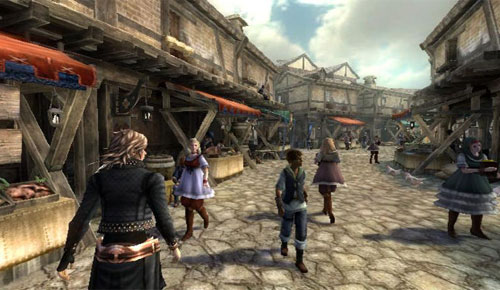
After a few basic battles, you get to a town area. The town area is large and feels like it's trying to pull off the bustling city feel of Assassin's Creed, except this is the Wii and it can't handle it at all. The framerate drops to about 10 fps. Your character's movement feels very slow and clunky, whether it be because the system can't handle the amount of detail or because the frame drops are so frequent that you're basically playing in slow motion. The controls are awkward due to how crappy the classic controller is -- something that could be fixed by having the more expensive one, probably, but that's their fault. The graphics are all washed out and drab, much in the way that modern next-gen games are. In many ways, Last Story seems like it's trying to imitate western-made, high-budget PS3/360 games.. except that it's a Japanese RPG on the Wii and none of this makes sense. The whole game feels clunky and jarring.


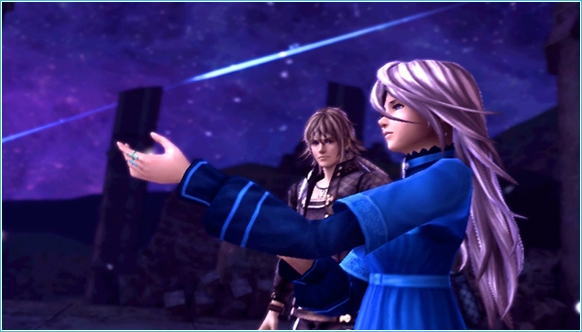
After 3-4 fetch quests that slowly orient you to the huge city that you're in, you meet a girl that's running away. She is the spitting image of every female protagonist that you've ever seen: weak, clueless, mysterious, magical and attractive. The main character and her run around the city for a while, talking awkwardly and looking at stars and talking about their sad lives and all the things that JRPG protagonists do in every other JRPG you've ever played. The character is still moving slower than you'd like and none of this is particularly interesting. The pedigree of the developer makes you push on, but if this had a different name on the box I probably would drop it right about now.


And then, finally, something interesting happens. The game climaxes and things blow up all over the place. You get to play with the battle system some more and it slowly starts to make sense. The characters start to become more interesting due to actually having some impactful events happen. After 4-5 hours of having no idea who these guys are, it starts to click. Antagonists finally show up. It's starting to feel like a PS1 Final Fantasy game and that's a really good thing. The things that Last Story is going for narratively are not particularly original, but they're fun. There's something to be said about fighting a battle that has some emotional weight to it instead of just slaughtering random packs of bugs for no reason.

The Last Story is kind of a crazy game. It's really creative in some ways and utterly devoid of content in others. There is so much to the battle system that mechanics are still being introduced as late as 3-4 hours before the ending. The game has a battle tutorial that seems to pop up every other fight for the first five hours, and is maybe the only RPG battle tutorial that I've had to refer back to after the fact. At the same time, the heart of the battle system is walking up to an enemy and letting your guy auto-attack him to death, whereupon you'll find a new enemy to do it to. This isn't a complaint -- you can turn auto-attack off if you want and make it more of an action RPG -- but sometimes the complexity of a battle system masks the fact that you're really just letting the game play itself. Ultimately, the battle system is a positive because a.) the fights are fun to do and b.) killing enemies and getting loot is pretty rewarding. Plus I have to give Last Story credit for trying something new.


I don't know how you could possibly be hiding when your sword is that fucking big, but whatever.

There is exactly one town in Last Story, and it's more of a hub world than anything. You visit a tavern, the streets, a castle and some shops. Occasionally you'll walk around and talk to people on a ship but that's it. The dungeon areas are narrow, linear pathways with large rooms for large-scale fights. Level design-wise, it's very similar to a character action game like God of War or Devil May Cry -- or, if you want to go that route, Final Fantasy XIII. You'll get large circular rooms so you can face off against foes and small branching pathways to pick up treasure chests. Action is broken up into 15-20 minute 'chapters', and you can sometimes finish a chapter by just talking to people or hitting a trigger point. It feels bizarre to be on chapter 18 in 3 hours of play, but that's just how Last Story rolls. It's bite-sized and modern. The game is over in 25 hours, 15 if you ignore the sidequests (which are trigger points followed by a scene fight or an arena battle, mostly). All of this could be seen as a negative -- or it can be seen as cutting to the heart of what makes an RPG so good: pacing, boss battles and good scenes. Last Story does a very good job in these areas, and while the bosses are standard large monsters that aren't very engaging on a narrative level, they make good targets for the unique battle system. For all of the things Last Story does wrong, it manages to nail the gameplay in a very satisfying way.

I don't think there are more than 15 named characters in the entire game, and you start out with half of them in your party. Antagonists are largely absent, replaced by a political plot focused on an external threat of invasion that is never quite explained. And yet the characters that are there are quite excellent: they seem fairly one-dimensional at first, but I'd call Last Story's cast one of the least offensive in the history of the genre. Every single character resonates in some way and the localization is fairly impressive. There are no annoying kids -- or any kids at all, really -- and no stupid characters that have no purpose other than to annoy you. Last Story's characters won't hit the highs that other games in the genre may have, but it also lacks the usual whiny, insufferable garbage. By the end of the game -- one that isn't particularly long -- you're fairly attached to this rag-tag bunch of misfits.


When Last Story ramps up towards the end, it kind of takes you by surprise: hey, this game is kind of fucking awesome. It kind of sneaks up on you and suddenly you can't put it down. The pacing is strong and the characters keep the so-so plot on track. The framerate is still crazy and the colour palette is still washed out, and it's extremely limited in scope, but you start to ignore that and instead enjoy all of the crazy things happening on-screen. You start to get some really strong weapons and abilities and you really look forward to the next battle. Everything just comes together at the right time and it feels triumphant. Holy crap, this game is actually firing on all cylinders. It may not always be awesome, but it will definitely be memorable. It's got heart, it's fun to play and it's unique. Japanese RPG fans should definitely give it a try.

Wednesday, March 14, 2012

Thoughts - Persona 3 Portable (PSP)

Been meaning to get some thoughts on paper (textbox?) lately. Here's my attempt at writing a mini-essay about a game I have real thoughts on.


Persona 3 is a long damn game. It manages to stretch what should be a 20-30 hour adventure into 60-70 hours due to pure repetition and grind. The game consists of one endless dungeon that spans literally hundreds of floors, and the design of the floors never changes with the exception of a change to the tileset. Every on-screen enemy that you find in these dungeons looks the exact same from the first hour to the last. You will hear the same dungeon and battle song for dozens of hours, and while you can change the music if you want, it’s usually not worth it.

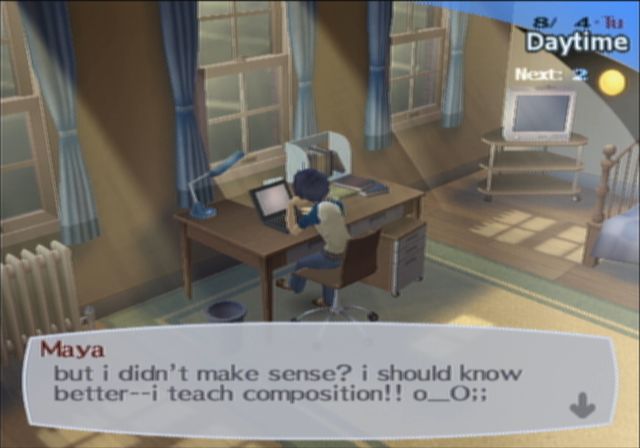
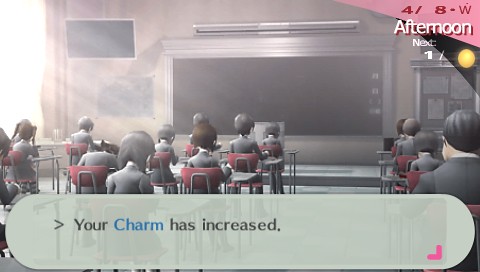
Persona 3 splits its gameplay into two main sections. During the day, you go to school, take tests, make friends and advance your relationships. This process, like most things you’ll do in Persona 3, is very repetitive and without a whole lot of depth. You talk to a person, say you want to spend time with them, make a couple of choices which will advance your relationship in various ways, gain a relationship level and then go back to your dorm. Every relationship has 10 levels and advances in much the same way. The times of the day are segmented in much the same way as the relationship levels: during school, after school and evenings.

At night, you go into the endless dungeon and kill shadows. After battles, you collect monsters called personas and can combine them into new monsters at the entrance to the dungeon. Your aforementioned relationship levels give you experience bonuses upon creating new monsters, and beyond this, the school sim and dungeon aspects are completely separate.

Even the story sections of the game are compartmentalized. Every major event happens when a full moon comes, and by “major event” I mean “boss fight”. For the first 75% of the game, there is little to no storyline, just a general “we gots to stop the shadows!” theme that never really resonates (or even tries to resonate, really). Persona 3 is a game based on the gameplay – there are story bits and they can get pretty expansive towards the end of your 70 hour quest, but overall, this isn’t a game you’re playing to advance the narrative.

Instead, you’re playing against the clock. Everything in Persona 3 is timed: certain people are around at certain times. Your day is split into 2-3 time blocks. The boss fight will come in x number of days, a number that is prominently displayed on the top of your screen for the entire game.


The purpose of playing is to strengthen your character in time to be able to handle the next major event. You continue doing this until your quest is at an end. At no point is it about anything other than getting stronger. Strengthening your relationships so you can strengthen your personas so you can level up your characters so you can learn new skills so you can advance to higher levels of the dungeon so you can gain more experience so you can level up your characters better so you can beat the boss, and to beat the boss you’ll want to strengthen your character relationships so you can strengthen your personas… and so on. It never ends. It is an endless cycle, just like the moon that is sitting on your screen with a number telling you how much longer you have until some evil shadow is going to jump you. When you finish playing Persona 3 – whether it’s by choice or because you finished it – it’s more a feeling of relief, of getting rid of the constant time pressure that you’ve been under for dozens of hours. A weight lifts off of your shoulders and you live life just a little bit slower.

And despite all this, Persona 3 is probably in my top 10 games of all time.

I cannot think of a game with a better sense of progression than Persona 3. There are an infinite number of small improvements you can make to your characters, all of which make you feel really good. Everything in Persona 3 is very carefully and deliberately designed with progression in mind. You have a limited amount of time to get everything done, forcing you to make hard decisions about how you’re going to spend it on a day-to-day basis. Should you level up your academics stat so you can do well on the test so the smart girl will pay attention to you? Or will you work on advancing your courage stat so you can impress a sports team? Do you want to ignore all stats and friendships and just pay money to increase your stats? Or will you forget all that and just hang out with a friend and advance that social link? Or you can skip all that and just level up in the dungeon – but you can only do that for so long each night because your characters will get tired. Unless you’re just blindly following a FAQ from beginning to end, you can’t do it all. You have to pick and choose how you develop your characters.


The game has a level of difficulty to it that demands smart decision making. This extends to more than just battle. Having the right combination of skills means everything in P3 and the easiest way to advance your characters is to create personas using those social links that you’ve forged during the daytime. Persona 3 isn’t hard so much as it is smart: you have to make the right choices in battle and one mistake will kill you very, very quickly. The battle system has a high risk/reward aspect to it since you can get bonus turns for hitting opponent weaknesses. The key is to have the skills that you need in order to maximize your chances of success. Persona is notorious for stories about missing an attack on an enemy and getting utterly annihilated because the enemy went after your weaknesses and killed you without you getting another turn. That sense of tension – that you can die at literally any time – is key in making the game’s choices feel worthwhile.

There are so many stats to advance that you often feel like there’s no right thing to be doing. You end up playing favourites and picking out what you like best. Maybe you want to ignore the kid that likes to eat and instead want to hang out with the kid that’s dying and wants a friend. Or maybe you think that kid’s a whiny brat and you want to just sit at home and play an MMO, complete with netspeak. Persona 3 features some smart writing that keeps you engaged despite the silly premise.


Perhaps the most important thing to making this all work, and something exclusive to the PSP version of the game, is how incredibly fast the game plays. In P3P, you don’t even control your character directly: instead you move a cursor around the screen. You can instantly warp to anywhere instead of having to walk around. You can hold a button to have text zip past the screen at 100 miles an hour. There’s an auto-attack button in battle that makes things fly. Battles go very fast thanks to the fact that you’re either going to murder the enemy or see the game over screen within 15 seconds.


Combine the endless sense of progress, along with the blistering pace at which you can make time pass and you have an incredibly engaging game, one that’s very hard to stop playing. Persona 3 Portable turns me from a regular person who likes to play video games into an addict who is sitting there slamming the button to get a new ability, level or item. It’s classical conditioning at its apex and it’s incredibly effective. I sit there drooling like a brainwashed animal waiting for the next level up jingle to play. When I do get it, a smile comes across my face, I breathe a sigh of relief and do it all over again. Suddenly it’s 2:30am and I don’t know what I’ve been doing for the last four hours. It’s heroin in video game form and I cannot get enough of it.


I love this stupid game. It’s got great music, an awesome sense of style and all those things that everyone likes in their RPGs, but ultimately It’s not about that. That’s not why the game is so good. It’s everything smushed together and how the game functions as a whole instead of dissecting the individual systems. The recipe is just perfect.